
Investing for Escalating Education Expenses
LATEST NEWS

Investing for Escalating Education Expenses
| Question: What is the best investment strategy to save for our children’s future education expenses (nursery to high school) from birth and, if you’re starting to invest late, for those already in school? "The question on every parent’s mind is ‘how am I going to pay for my child’s education when interest rates are up and the economic pressure is on?’ Institutions such as Old Mutual, Momentum, Sanlam and Discovery have offered their solutions to the problem with products ranging from flexible investments to tax-free savings. When one looks deeper into the investment options there are three factors to consider: |
|
|
|
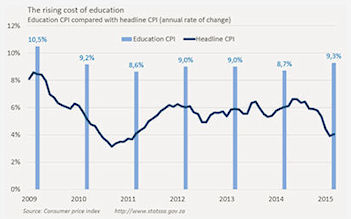
| The option of choice would be a simple, tax-free savings account that allows you to save R33 000 a year. These products are easy to access, they are cost effective and you can access the full capital amount at any point without penalties. What return should I target? One of the concerns for investors who are saving for their retiremen,t is being able to make a decent return over and above inflation. As you can see below, education CPI (Consumer Price Index), is considerably higher than that of headline CPI. |
|
 |
|
| On average, an education fund must get a return of 9% compounded per annum to keep up with education inflation. This would suggest that an investor should target a return which is consistent with that of a multi-asset high-equity fund, if not that of a full equity fund, depending on the client’s risk profile and time frame. This is necessary to ensure a net real return (a return net of costs and inflation). According to the following cost-escalation graph, published on Old Mutual’s website, both private high school and university fees will become frighteningly expensive. |
|
 |
|
| The graph below provides a sobering reminder of how one must prepare for the costs of educating our children. | |
 |
|
| When should I start saving? | |
| If your child was born in 2016 you should contribute a monthly amount of R1 000 to R1 500 escalated at 9% per annum, with the aim being to fully fund your child’s tertiary education. R1 000 per month escalated at 9% pa over 18 years, with an estimated annual return of CPI (6%) + 7 compounded annually, gives an estimated capital amount of R832 419. | |
 |
|
| If your child was born in 2016 you should contribute a monthly amount of R1 000 to R1 500 escalated at 9% per annum, with the aim being to fully fund your child’s tertiary education. R1 000 per month escalated at 9% pa over 18 years, with an estimated annual return of CPI (6%) + 7 compounded annually, gives an estimated capital amount of R832 419. This capital amount should be able to fund three years of university (a bachelor’s degree) at an estimated cost of R237 000 per year. If you have been unable to start an educational fund early on in your child’s life, then you are running up against the clock. Your savings strategy should not deviate from that of the above. The variable that will have to change is the amount that you contribute each month to make up for the time lost. The numbers could therefore turn out to be unrealistic. Life Insurance: It’s a good idea to include a life cover policy on either one or both parents. The amount does not have to be excessive. The unfortunate chance of dying in a car accident can leave a child vulnerable to having no possible means to pay for their education. Note that the examples and graphs above illustrate possible rates, solutions and outcomes. These assumptions can and will change from time to time. It’s hard to generalise and advise on what the reader should do when it comes to investing for a specific purpose over a long time frame. This article gives readers an indication that the possible expenses of educating our children, will require us to make preparations long in advance. |
|
 |
|
| Perhaps the best advice that one can give is to suggest that you utilise the services of a financial advisor to create a realistic educational plan that they can tailor to your circumstances. Each year they should review your circumstances and advise accordingly." | |
| (Jesse Morgans is a Wealth Management Consultant at Asset Protection International). | |
| Credit To: Morgans, J. (2017, May 04). Investing for Escalating Education Expenses. Moneyweb. Retrieved from: https://www.moneyweb.co.za/mymoney/moneyweb-financial-planning/investing-for-escalating-education-expenses/ | |
| Broker Directory – Smart insurance advice brought to you by professional insurance brokers! | |
Back to Latest News